
A Simple Checklist to Evaluate Any Company, Quick and Dirty
Get Smarter About Analyzing a Company Fast and Sensible

Food For Thought
“I am a better investor because I am a businessman, and a better businessman because I am an investor.”
- Warren Buffet
To lead a fulfilling life and career, we need to be growing, on a daily basis ideally, and I want to help you (and myself) achieve that.
Each week, I will be sharing specific tips or simple concepts relevant to today’s business and tech world that will enhance your knowledge and wisdom. I believe these insights will prove valuable when interacting with superiors, meeting clients, socializing with colleagues and friends.

Today is a short sharing on a business evaluation framework that I use whenever I need to analyze a company quickly.
Whether you are an entrepreneur, investor, operator, journalist or business analyst, it is important to have the ability to understand and evaluate a company effectively.
To many folks, conducting a robust company fundamental analysis can be daunting. Indeed, there are numerous tasks to cover if you want to do it professionally — researching the company’s industry, reviewing annual filings, assessing its business and financial condition, comparing its performance against industry peers, conducting valuation analysis, and forming a solid opinion on the business. That’s just an abridged version of the steps required for a proper company analysis.
However, analyzing a company is not as complicated as it may seem. Let me share with you a simple framework that has helped me analyze hundreds of companies throughout my career as a corporate finance professional and an operating leader.
Breaking Down the Key Facets of a Company
Whenever you encounter a daunting problem, try breaking it down to pieces, up to the sizes that you can digest.
To properly understand and analyze a company, here are the six broad aspects to cover:
Business Operation and Strategy
Industry
Financial Performance
Shareholders and Management
Risk Factors
Valuation
Understand & Evaluate
Next, you need to both 1) understand and 2) evaluate each aspect.
Based on the sections above, I came up with a model checklist with two major parts:
A list of questions that lead to a better understanding of the business.
The ideal situation of the company in response to the question list.
In Part 1, you want to learn as much as you can about the company and the industry. In Part 2, you evaluate the company by assessing whether its various business aspects align with their ideal situations.
Here is the model checklist:
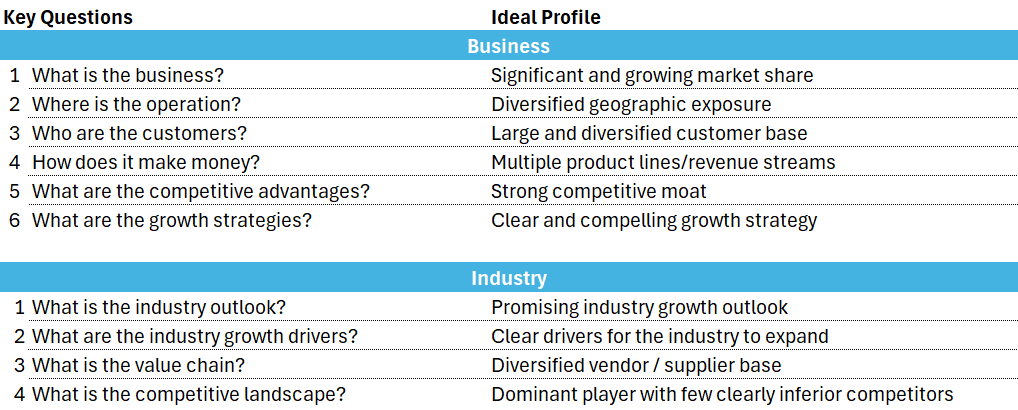
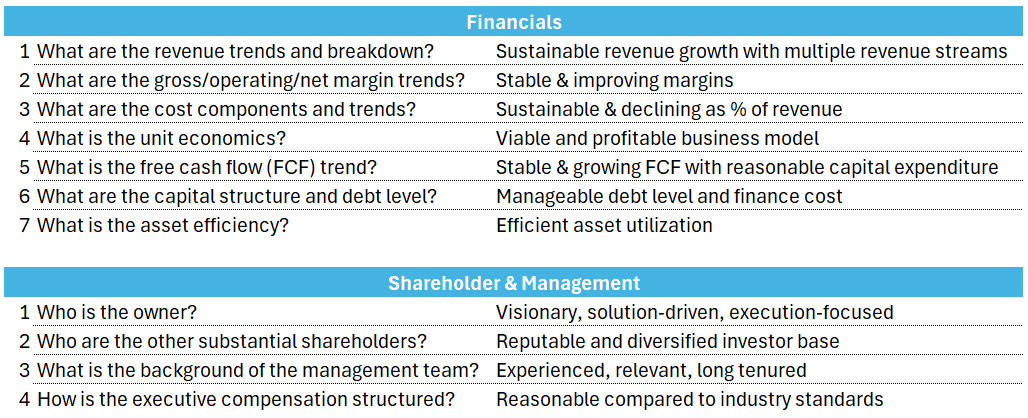
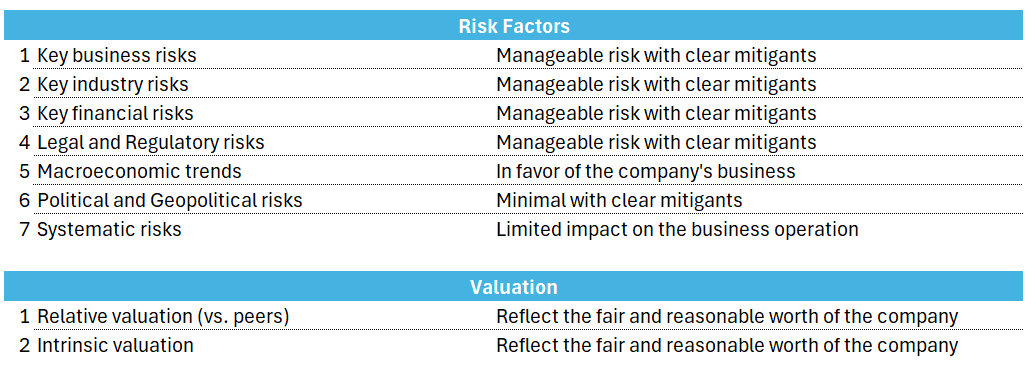
While this framework is not exhaustive, it serves as a generic guide for me when conducting a quick-and-dirty but sufficiently sensible company evaluation.
For each aspect, the closer the company is to its “ideal profile”, the more likely it is a sound business. Conversely, if the company demonstrates a mediocre profile across many of its business aspects, it is a warning sign.
The importance of each aspect may vary depending on the stage and industry of the company, as well as the purpose of your analysis.
Each section and question can be broken down into sub-categories and follow-up questions as you conduct deeper analyses on the business.
Once you have completed your evaluation, you can triangulate your analyses and formulate your unique viewpoint on the company.
The More Important Elements to Analyze a Company, if I have to Pick
Business: What are the company’s competitive advantages?
Industry: What is the competitive landscape?
Financials: What are the revenue, profit margins and free cash flow trends?
Valuation: What is the valuation assessment?
Here are additional aspects I would pay attention to for the following types of companies:
Start-ups and early-stage ventures:
Who is the founder?
How does the business make money?
Focus on revenue trends more than profit; assess cash burn rate
Unit economics
Large and mature companies:
Capital structure and debt level
Asset efficiency
Growth strategies
Management team
By considering these elements, you can gain a deeper understanding of the company and make more informed evaluations.
Kindly note that this framework is not a one-size-fits-all solution and should be adapted based on your specific analysis requirements and the nature of the company that you are assessing.
Skills enable outstanding work. Knowledge is power. Experience enhances judgment. Execution is everything. Persistence wins.